

WHEN SILENCE SPEAKS: THE RIGHT TO WITHDRAW WITH PROFESSIONAL DIGNITY
04 Aug 2025WHEN SILENCE SPEAKS: THE RIGHT TO WITHDRAW WITH PROFESSIONAL DIGNITY
04 Aug 2025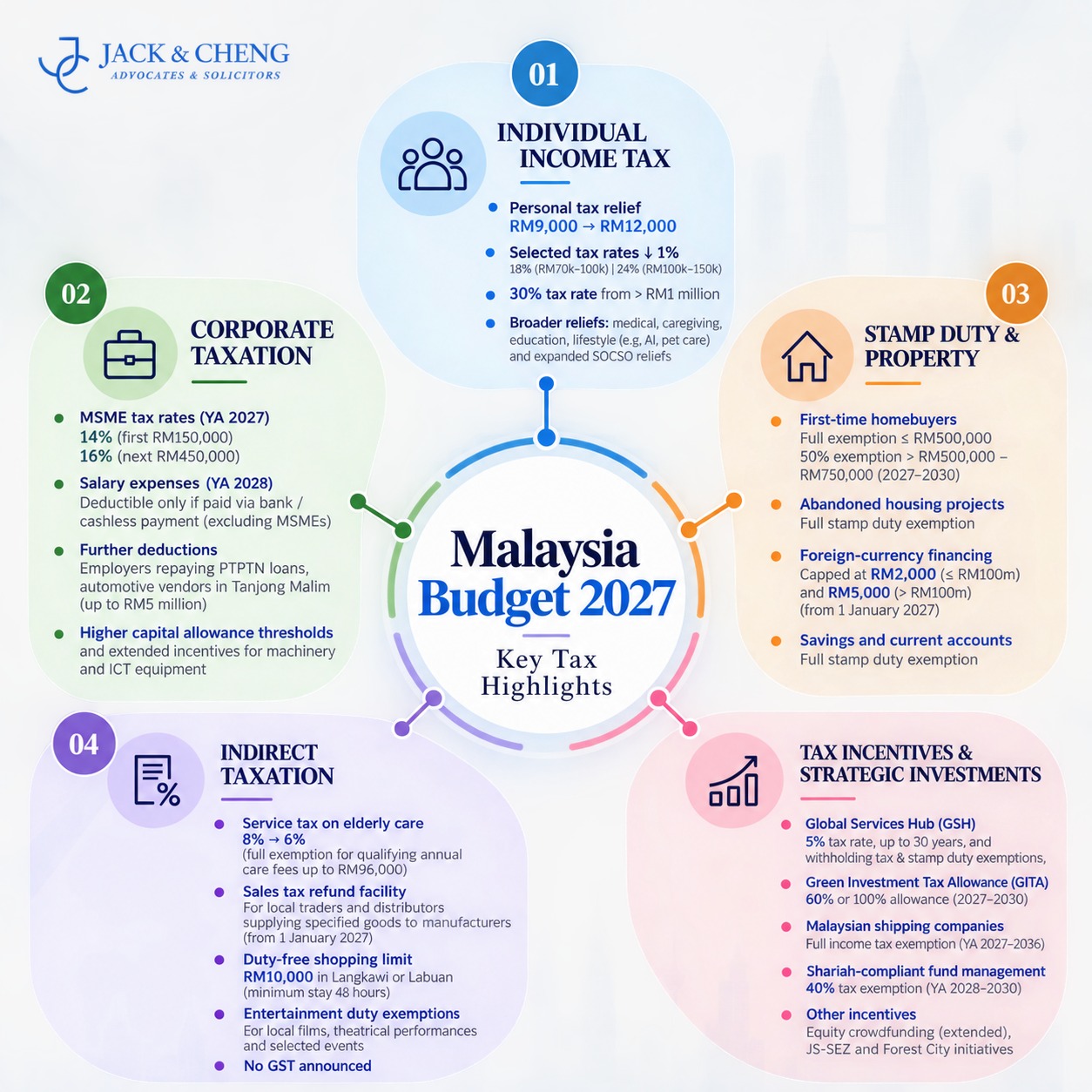
16 October 2026
MALAYSIA BUDGET 2027 | TAX RELIEF, BUSINESS GROWTH & COMPLIANCE — A LEGAL PERSPECTIVE
AUTHOR: NG JACK MING (Partner)
Budget 2027
introduces several welcome changes for individuals and businesses, including
lower income tax rates, additional tax reliefs and enhanced incentives. These
measures are encouraging, particularly at a time when rising living and
operating costs remain a concern.
However, beyond the immediate tax savings, there are broader questions worth considering. Who stands to benefit from these measures? Will the incentives translate into meaningful economic growth? And what does the law require for taxpayers to claim them?
The accompanying infographic provides an overview of the key tax proposals under Budget 2027. Three developments deserve closer attention, particularly in terms of their practical implications and the legal considerations involved.
1. Individual Income Tax: Who Benefits?
One of the more notable proposals is the increase in personal tax relief from RM9,000 to RM12,000, alongside a 1% reduction in selected individual income tax rates. The proposed increase in personal relief is particularly significant, considering that it has remained unchanged since 2010.
According to the Government, approximately five million taxpayers are expected to benefit, with potential annual savings of up to RM1,600. While this is a welcome development, the actual savings will differ depending on each taxpayer's income and available reliefs. Whether these savings will meaningfully ease the rising cost of living remains to be seen.
At the same time, the 30% tax rate will apply to chargeable income exceeding RM1 million, instead of the existing RM2 million threshold. The direction is clear. The Budget seeks to provide greater relief to a broader group of taxpayers while placing a higher tax burden on higher-income earners.
From a policy
perspective, this reflects an attempt to balance tax relief with a more
progressive distribution of the tax burden. However, the effectiveness of these
measures will ultimately depend on whether the additional disposable income
translates into meaningful improvements in household finances.
2.
For qualifying micro, small and medium enterprises ("MSMEs"), the preferential income tax rates are proposed to be reduced from 15% to 14% and from 17% to 16% for the first two chargeable income bands.
To put this into perspective, an eligible MSME with chargeable income of RM600,000 could enjoy annual tax savings of RM6,000. While this may appear modest, the savings could provide some financial relief to smaller businesses managing their cash flow and rising operating expenses.
Together with enhanced capital allowances, financing-related stamp duty reliefs and targeted investment incentives, these measures are intended to encourage businesses to invest in equipment, technology, expansion and other productive activities.
However, tax
savings do not necessarily translate into business growth.
There is also
an important legal and practical consideration.
For businesses
considering new investments or expansion, understanding these conditions is
therefore just as important as identifying the potential tax savings.
3.
This is
perhaps one of the more interesting changes from a legal perspective. From YA
2028, businesses other than qualifying MSMEs will only be entitled to claim
salary expenses as tax deductions under S.33 of the ITA 1967 if the payments
are made through prescribed banking or cashless payment channels.
Why is this significant?
Under Section 33(1) of the ITA 1967, the general principle governing business deductions concerns expenses wholly and exclusively incurred in the production of gross income, subject to the other applicable statutory provisions. Salary expenses incurred in the ordinary course of business would generally be considered in light of this principle. However, the proposed restriction introduces an additional consideration. An expense may be genuinely incurred for business purposes, yet its deductibility could depend on the manner in which payment was made.
This illustrates how tax legislation is increasingly being used not merely as a means of collecting revenue, but also as a mechanism to influence business conduct and encourage regulatory compliance. In practical terms, payroll arrangements may no longer be viewed merely as administrative or employment-related matters. They could also have direct tax consequences.
Businesses should therefore pay closer attention to their payment procedures and internal controls to ensure that otherwise deductible salary expenses are not jeopardised by non-compliance with the prescribed requirements. Nevertheless, the precise scope and application of the proposed restriction will depend on the final legislative provisions and implementation guidelines.
Key
Takeway
Budget 2027 is not simply about reducing tax rates or introducing additional reliefs. It also reflects a broader shift towards more targeted incentives and closer links between tax benefits, eligibility requirements and regulatory compliance.
For individual taxpayers, the measures may provide some relief from rising living costs. For businesses, the reduced tax rates and enhanced incentives may create opportunities for investment and expansion.
However, the proposed salary deduction restriction demonstrates that tax compliance is becoming an increasingly important consideration in determining whether a taxpayer is entitled to claim a deduction.
This raises an important distinction between the policy objectives underlying tax legislation and the legal requirements actually imposed by Parliament.
Tax legislation may be designed to encourage particular forms of business conduct, promote investment or strengthen regulatory compliance. Nevertheless, these policy objectives do not displace the need for clear statutory language when determining the rights and obligations of taxpayers.
In Exxon
Chemical (Malaysia) Sdn Bhd v Ketua Pengarah Hasil Dalam Negeri [2005]
4 CLJ 810, Gopal Sri Ram JCA observed:
“The maxim in revenue law is
this: no clear provision; no tax.
If there is any doubt then it must be
resolved in the taxpayer's favour.”
The Court
further recognised the principle that provisions in revenue legislation
favouring taxpayers should be construed liberally.
Notably, Exxon Chemical itself concerned the deductibility of employee benefit expenses under Section 33(1) of the ITA 1967. Although the factual and legal circumstances differ from the proposed salary deduction restriction under Budget 2027, the decision provides a useful reminder of the importance of statutory interpretation in determining the scope of tax deductions.
That said, the principle does not excuse non-compliance with conditions expressly imposed by legislation. Rather, it reinforces the distinction between what tax policy seeks to achieve and what the law actually provides.
This distinction becomes particularly important where tax deductions or incentives are made conditional upon compliance with prescribed procedures or requirements.
Ultimately,
while Budget 2027 offers welcome tax savings, taxpayers and businesses must
remain mindful of the legal requirements governing their entitlement to claim
them.
Tax policy may evolve, but the scope of any tax liability, relief or deduction must ultimately be determined by law, not administrative expectations alone.
Disclaimer: The measures discussed above are based on the Budget 2027 proposals and remain subject to the relevant legislation, subsidiary instruments and implementation guidelines.